
Plug It In. Earn. Repeat. Why CyberCharge Might Be Web3’s Next Big Habit Loop

Recently, $BCH has been on a roll, and the price of the currency has taken off, attracting many "old guys who left in the last cycle" back. Just when everyone was still talking about the bull market logic of BCH, CyberCharge (@CyberChargeWeb3) announced the launch of a cooperative version with BCH — directly pushing the "charging is mining" concept forward a big step.
This concept may look like a joke, but there is something deeper at the core: mapping real behaviour (charging) to the blockchain, and using crypto incentives to guide users to develop good habits, while building a new "data-power-asset" closed loop. BCH's access as a "payment-friendly chain" also makes it practical in real-world scenarios. I think that if BCH really wants to return to the basics from the meme market, CyberCharge's model — combining behavioural incentives with physical hardware — may be one of the answers.
Plug In and Mine: C2E (Charge-to-Earn) Incentive Mechanism
CyberCharge has a fixed "main income window" every day (currently about 5 minutes). As long as you charge within this time period, you can get rewards. Beyond this basic logic, the project has expanded into richer interactive gameplay:
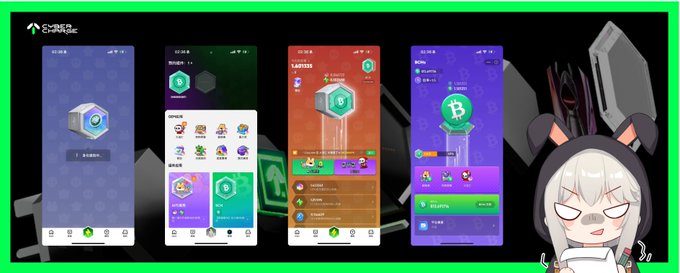
- AI Pet System: Users can obtain AI Doggies by purchasing modules, which support breeding, evolution, and sale. The more pets you have, the higher your output. You can also acquire rare resources through the "occupying mines" gameplay.
- Mini-Game Ecology: Each CyberChip module has different pre-installed games, some with GameFi elements, such as "Bounty Hunter," where you can play while charging and win rewards by competing on the leaderboard.
- Asset System: Gems and tokens accumulated in the app can be used to purchase props, improve efficiency, and even trade on-chain to build a sustainable lightweight economic system.
The entire experience has almost no Web3 learning threshold. It’s more like "non-sensory participation" — you are just completing the most natural action in life (charging your phone), but connected to the blockchain world.
Why did I choose the $BCH cooperative version?
I personally approve of the combination of BCH and CyberCharge for a simple reason: this chain is low-cost, efficient, and practical — perfectly matching this high-frequency, light-interaction behaviour.
- Project handling fees are almost zero. The cost of a BCH transaction is less than $0.01, so you don’t feel bad about charging or going online.
- Compared with Ethereum’s gas fees, which can cost dozens of dollars, it’s much more practical.
- The chain is not congested, providing a smooth experience.
- As a "peer-to-peer electronic cash" system, BCH is stable and has fast confirmation speed, which is ideal for real-time feedback scenarios.
The concept fits well and does not rely on hype to survive. CyberCharge emphasizes physical hardware + behavioural incentives, rather than memes, listings, and hype. It is a "slow-burning but reliable" product, consistent with BCH's pragmatic style.
Each charge can be recorded as an "independent behaviour," naturally adapting to the UTXO model. CyberCharge becomes a real "charging is asset" purchase portal.
"Check out CyberCharge here"
Web3 Made Effortless
Many people are deterred from Web3 not because they are "not interested," but because the threshold is too high — wallets, private keys, gas fees, bridges. CyberCharge directly hides Web3 in the actions we do every day — plugging in.
- You don’t need to understand the chain or its mechanism.
- Just plug in, and you can participate.
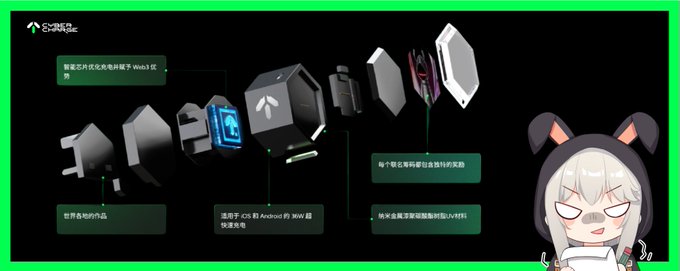
- The device supports mainstream Android/Apple devices — plug and play.
- All data generated belongs to you, can be checked on-chain, and is not controlled by the platform.
Just like the craze of making money by walking, "plugging in and mining" may become the next life narrative of Web3. Compared with many "invisible and intangible" blockchain projects, CyberCharge is a tangible, feedback-based Web3 entrance.
"Yuki invitation link"
Sustainability and Future Plans
We have to admit that all incentive models face the challenge of sustainability. If most users come just for rewards, retention may drop when returns decrease.
CyberCharge is expanding its boundaries — not just "making money," but building a Web3 "charging ecosystem":
- More chain access
- More modules
- More complete gameplay
- DePIN network layout
BCH itself may become the most stable "behaviour-on-chain bridge" in this system.Not every Web3 project needs to be a high-threshold, interactive behemoth. CyberCharge shows that the real popularisation of Web3 may lie in inconspicuous daily actions combined with BCH. With the price of BCH rising steadily, this approach is not just about market charts — it paves the way for real-life landing scenarios.
One is a practical public chain returning to the origin of payment; the other is a DePIN application redefining participation in Web3 through behavioural incentives. This wave of linkage is worth paying attention to.
